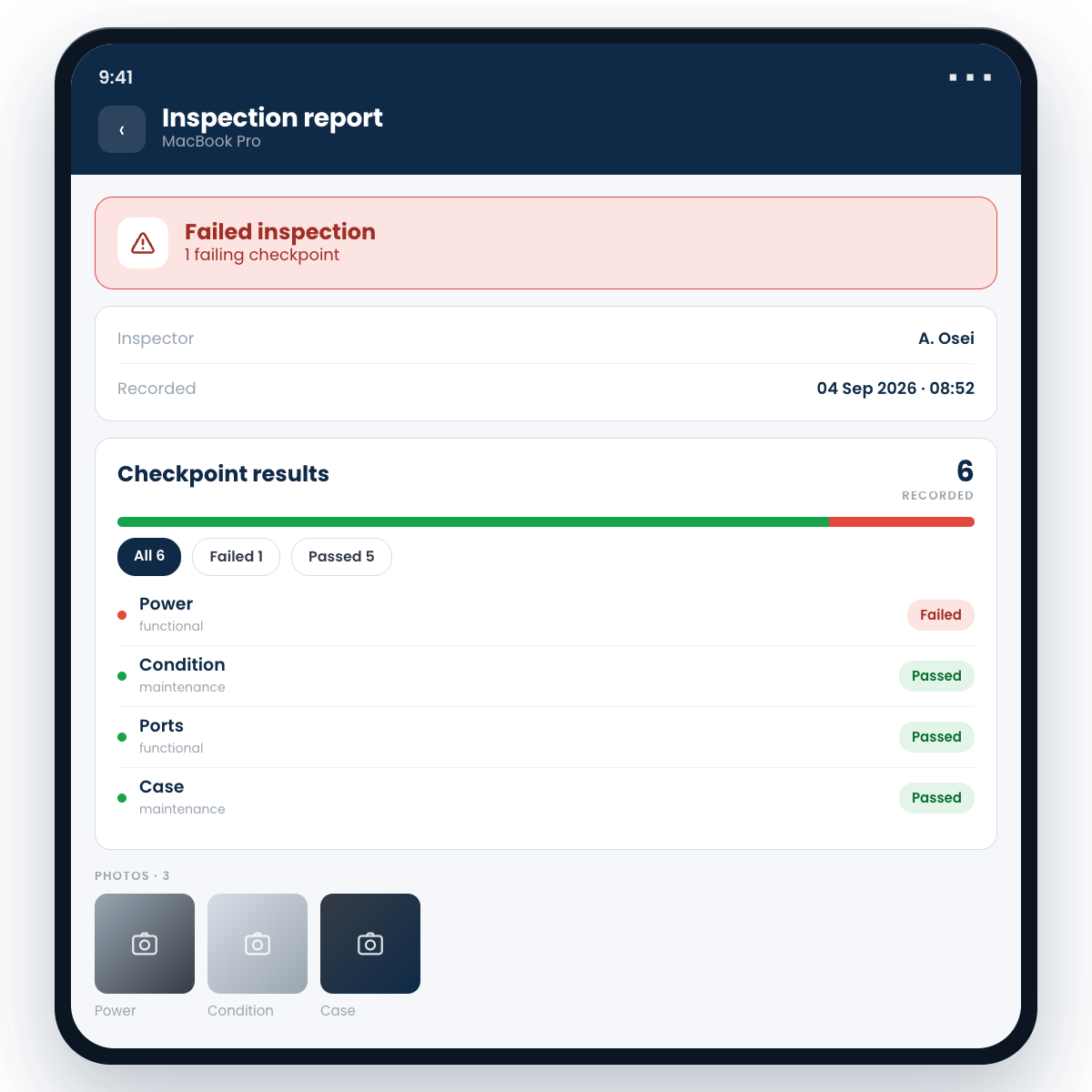
Three ways an asset can be unhealthy. We measure all three.

Condition, compliance and risk profile are different questions with different answers. Nova keeps them distinct and never averages them together — because the moment you do, the one that matters disappears.


One number hides the thing that will hurt you.

Most asset software gives you a health percentage. It looks decisive. It’s usually the average of several unrelated measurements, and averages are very good at producing a comfortable middle.

An asset in excellent physical condition with an expired certificate averages out to fine. An asset that’s fully certified and quietly cracking averages out to fine. Neither of them is fine, and in both cases the single number has told you the opposite of what you needed to know.

AXIS ONE

Condition — what physical state is it in?

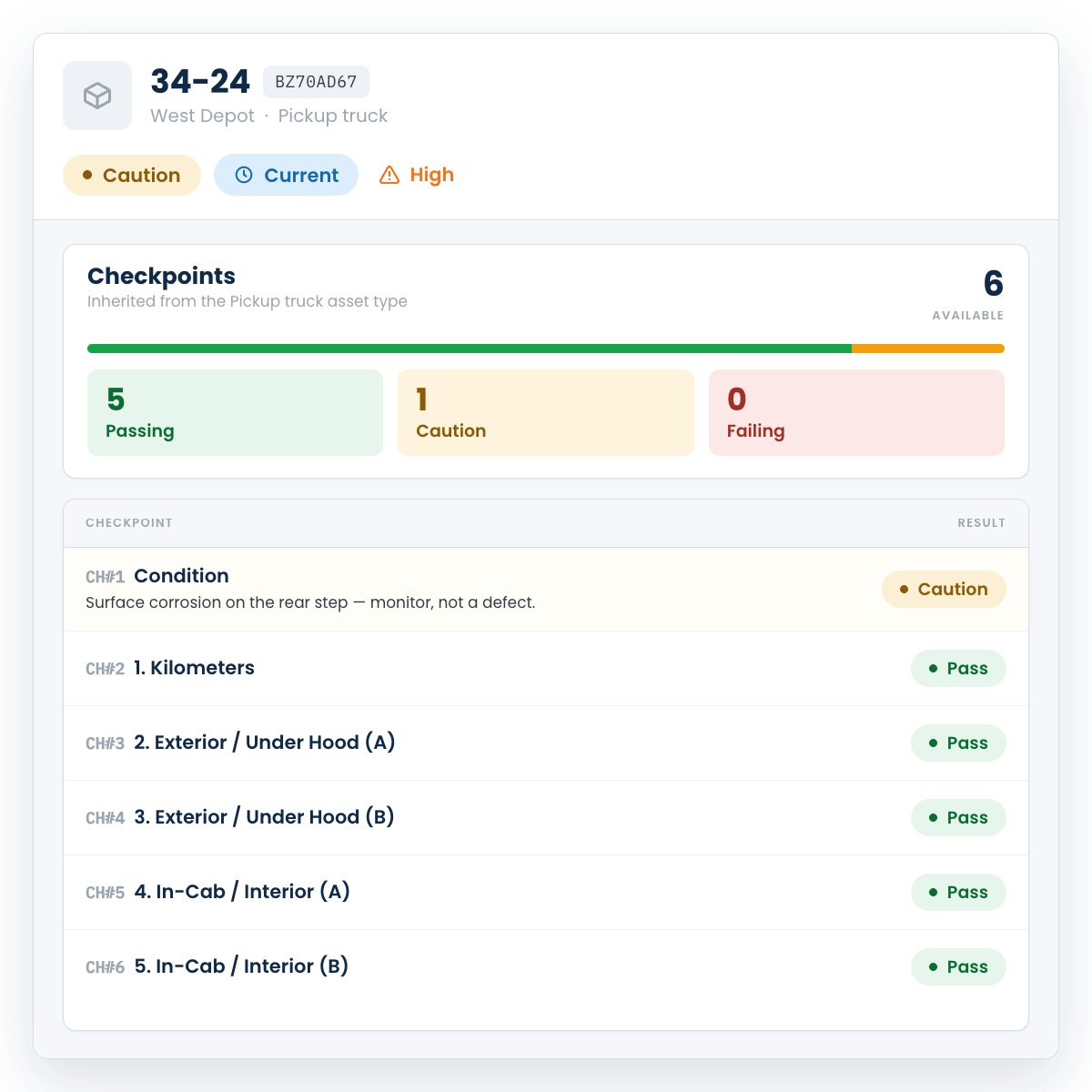
Condition measures the asset itself. Wear, damage, readings drifting out of tolerance, components degrading. It answers one question: if you walked up to this asset right now, what would you find?

It’s built from what inspectors actually observe and record at the asset, checkpoint by checkpoint — not from an age calculation or a depreciation schedule. Condition is the axis that moves gradually, which is what makes it useful as an early warning.
asset-health-axis-one-square-v2
ONE PLATFORM

Compliance — is every obligation inside its own window?

Current or Overdue. Every obligation carries its own clock. Checkpoints carry a frequency — the brake check monthly, the pressure test quarterly. Documents carry an expiry — a certificate, a licence, a test record. Each one runs independently of the others.

Current is deliberately the resting state, not a reward. Nothing on this axis renders green — because “the paperwork is in order” is not the same claim as “the asset is sound”, and a system that dresses both in the same colour invites you to read them as one.

  • Real-time sync between mobile and web
  • Real-time sync between mobile and web
mobile-inspection-report-square
AXIS THREE

Risk profile — set once, not observed.

You set a risk profile once, per asset type, in configuration. Two identical pumps in identical condition carry different consequence if one feeds a cooling loop and the other feeds a fire suppression system and only you can make that call, because it depends on your operation rather than on the equipment.

Unlike the other two, it doesn’t move. No inspection changes it. It isn’t a fault state and it never means anything is wrong. What it does is turn two long lists into one answerable question: how many critical assets are defective right now?

asset-health-axis-three-square-v2 (1)
WHY WE DON'T AVERAGE. 

No false greens.

A fire extinguisher can be perfectly compliant — every service on schedule, every timer fresh — and still be defective, because a real fault was found at the last check. It can also be overdue and completely functional. Most platforms collapse that into one status badge, and one of those two truths disappears. Nova lights them independently, because the gap between them is where people get hurt.

  • CONDITION
    • Functional
    • Caution
    • Defective

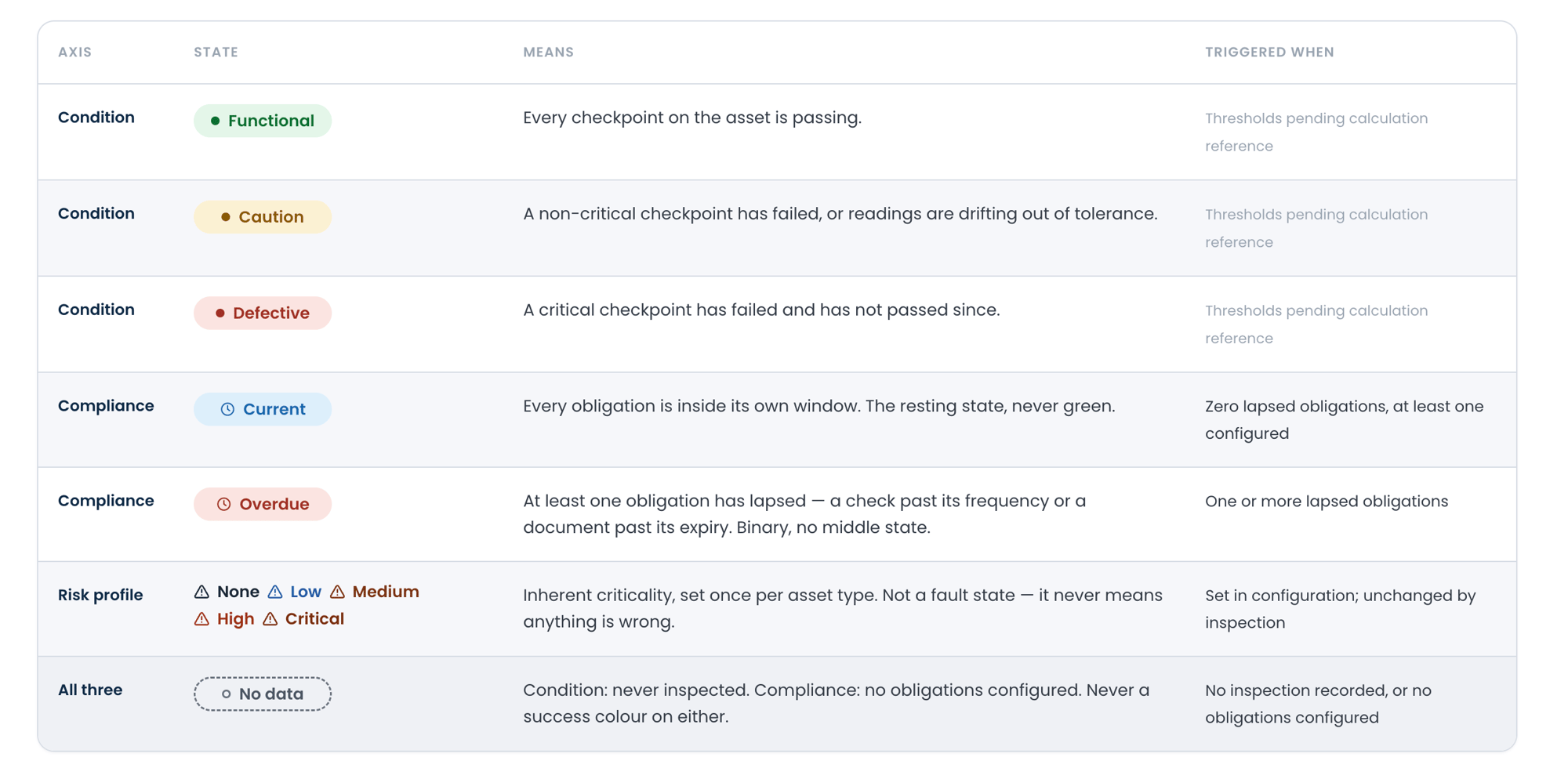
    Functional, Caution, or Defective — derived from every checkpoint on the asset, not from whichever checklist someone last happened to run. A failed check stays failed until it's re-inspected and passes. Nothing quietly clears itself.

  • COMPLIANCE
    • Compliant
    • Overdue

    Every checkpoint carries its own frequency and its own clock. Overdue is tracked per checkpoint — so "we inspected it last week" never masks the one check nobody has done in fourteen months.

  • RISK
    • Criticality you define

    You define inherent criticality per asset type. Nova cross-references it against live condition and compliance, so your dashboard answers the question that actually drives the day: how many critical assets are defective right now?

CHECKPOINT-LEVEL MEASUREMENT

Problems don’t average away.

Averaging hides things in a second place: inside a single inspection. An inspection with forty checkpoints, thirty-nine passes and one failure, reads as a pass in most systems. The failure is absorbed.

Nova keeps every checkpoint as its own record. A checkpoint that fails repeatedly is visible even when every inspection it belonged to passed — the same hydrant failing its pressure check three quarters running, inside three inspections that all came back clean.

That’s what makes the condition axis worth trusting. A health signal built on inspection-level pass/fail is built on data that was rounded off before it arrived.

checkpoint history
HEALTH STATES

Every state, and what it means.

Health states are deliberately plain. If a badge needs explaining in a meeting, it’s the wrong badge.


At the checkpoint

Truth gets recorded. Each checkpoint holds its own condition result and its own compliance clock. This is the only level where anything is observed.

At the asset

Condition and compliance roll up by worst case rather than by average. One failed critical checkpoint makes the asset Defective however many others passed. One lapsed checkpoint makes it Overdue. Risk profile doesn’t roll up at all — you assign it by asset type and it applies downward.

Across the portfolio

There is no single score. There’s a population: how many assets sit at each intersection of risk profile, condition and compliance. The headline isn’t a percentage, it’s a count. 

Screenshot 2026-09-07 at 9.19.44 PM

Frequently asked questions

What is an asset health score?

A measure of whether an asset is in a state you’d be comfortable relying on. Nova splits it into condition, compliance and risk profile rather than combining them into one figure, because those three things move independently and a single number obscures which one is the problem.

Why keep three signals instead of one score?

Because they answer different questions and don’t correlate. A new asset can be Functional and Overdue at once. A fully certified asset can be Defective. A Functional, Current asset can still be the one you can least afford to lose. Averaging them produces a middling number that describes none of those situations.

How is the risk profile calculated?

It isn’t calculated. You set it once per asset type in configuration, because criticality depends on your operation rather than on the equipment. It doesn’t move on its own and no inspection changes it. Nova cross-references what you’ve set against each asset’s live condition and compliance.

If an asset passes a later inspection, does an earlier failure clear?

No. A failed check stays failed until that specific check is re-inspected and passes. Nothing clears itself, and inspecting something else doesn’t wash out an outstanding fault.

What happens to an asset that’s never been inspected?

Its condition shows as No data. It does not show as Functional. An asset nobody has looked at is an unknown, not a pass, and treating it as green is how gaps in a register stay invisible. The same applies on compliance: an asset with no obligations configured shows No data, never Current.

Does this work for any asset type?

Yes. Because the signals are built from whatever checkpoints you define for that asset class, the model adapts to what you’re actually inspecting — a fire extinguisher, a haul truck and a footbridge each measured against their own checks.

Explore the platform

See what your assets are actually telling you.

Free forever on the starter plan. No credit card, no sales call.