
The inspector leaves. The fault shouldn’t.
Safety-critical equipment on the quay and at sea, each item on its own inspection cycle with findings that survive a crew change, a shift handover and a port call.
THE COMPLIANCE REALITY
Someone else decides whether you sail.
Marine safety is verified from outside. A port state control officer boards, a class surveyor attends, a harbour authority inspects the quay — and what they find determines whether the operation continues. In the worst case a vessel is detained, and unlike most compliance failures, that one is published.
Almost none of that turns on whether the equipment was inspected. It nearly always turns on whether you can show it — item by item, with the date, the finding and the name against it.
Between the inspection and the inspector there are usually two crew rotations and a handover.
On the quay and on board
-
Life-saving and fire
Lifeboats and davits, liferafts, immersion suits, EPIRBs, extinguishers, fixed systems, BA sets, fire dampers. Individually small, collectively the entire safety case.
-
Lifting and handling
Quay cranes, RTGs, reach stackers, spreaders, ship’s cranes, chains, slings and shackles. Statutory examination cycles and the heaviest consequence in the operation.
-
Structure and access
Quay edges, ladders, gangways, walkways, handrails, hatches, confined space entries. The checks most often done informally and least often recorded.
The person who found it signed off three weeks ago.
Crew rotate. Shifts change. A defect noted on a Tuesday belongs to someone who is off the vessel by the time it matters, and the handover note that carried it is one of forty things in a folder.
Nova holds the finding against the specific item, not against the person or the visit. A failed check stays failed until that check is re-inspected and passes, not because the next round came back clean, not because a different inspector walked the same deck, and not because the vessel changed hands. The photograph and the name stay attached the whole way through.
When an inspector asks what was found and what happened next, the sequence is on the record whether or not anyone involved is still aboard.
- A failed check persists until that specific check passes
- Attributed and timestamped, so the sequence survives a rotation
- Photo evidence attached to the item, not the report
- Full history per item across every crew and every port call
No signal, no problem, no paper.
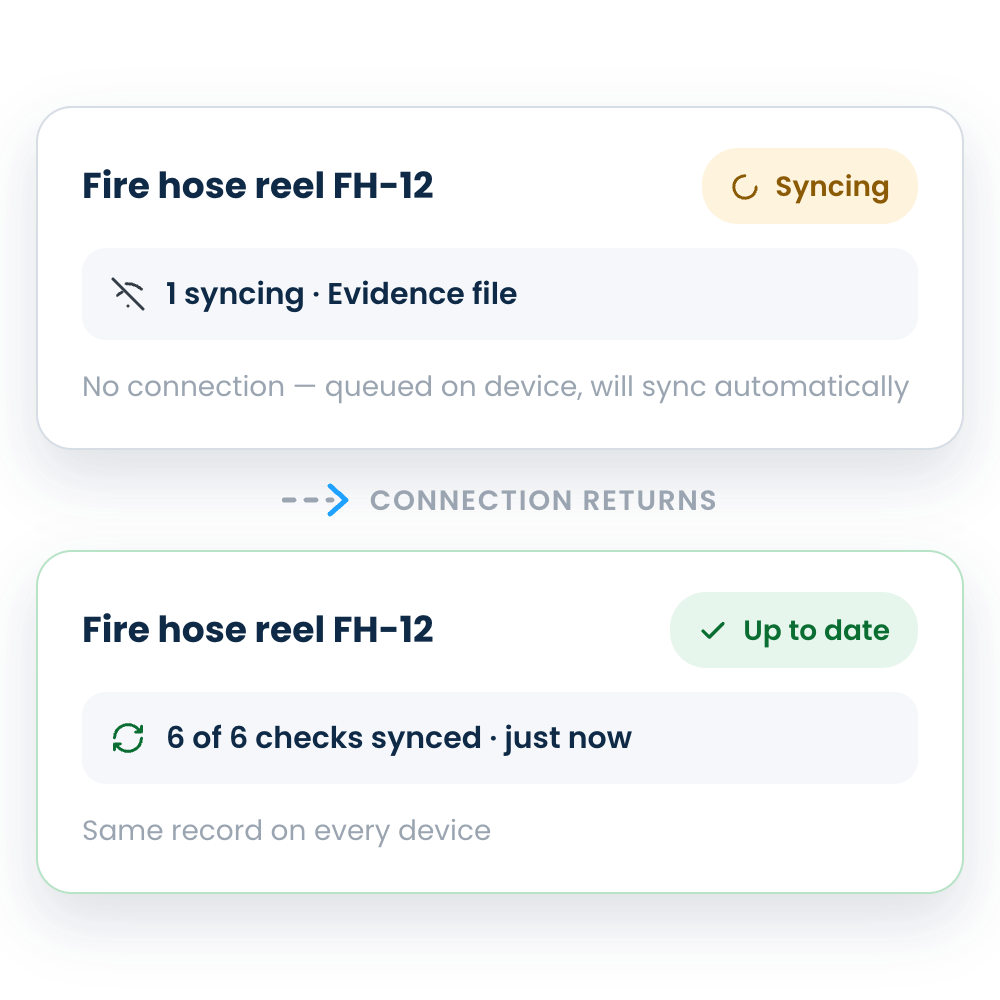
At sea there is often no usable connection, and satellite bandwidth is not for inspection uploads.
Inspections complete on the device and sync when a connection returns so the record is made at the item, in the machinery space or on the quay, rather than reconstructed later from notes.
- Real-time sync between Offline inspection with automatic sync, from the Essential plan and web
- Photo evidence attached to the specific check
- Timestamped and attributed, locked on submission
- Failed checks persist until re-checked and passed
It works. It’s still not ready.
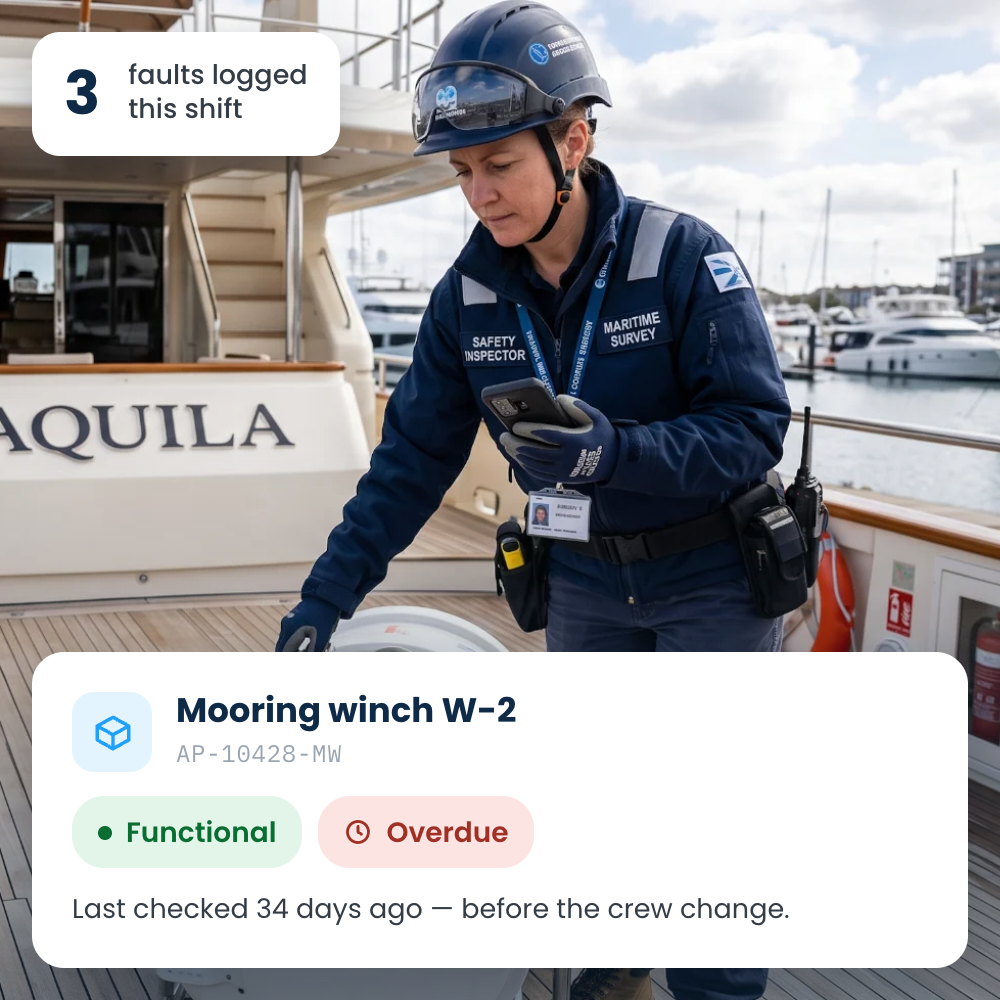
Take a lifeboat davit. The winch runs, the brake holds, there’s no corrosion of note. Condition: Functional. Its load test lapsed while the vessel was on a long charter. Compliance: Overdue. It’s the primary means of getting everyone off. Risk profile: Critical.
Nothing about that davit looks like a problem, and a single blended score would call it amber.
Kept apart it says the equipment is sound, the evidence isn’t, and this is the one you handle before anything else in the yard.
Frequently asked questions
No. Nova is not approved by any class society and isn’t a substitute for an approved planned maintenance system or a survey arrangement. It records inspections and holds the evidence — what was checked, when, by whom, and what was found. Where you need an approved PMS, Nova sits alongside it.
No. Planned maintenance, purchasing, crewing and certificate management stay where they are. Nova covers the inspection and evidence layer, particularly for safety equipment where the record matters more than the schedule.
Yes. Inspections complete on the device and sync when a connection returns. Offline capture is available from the Essential plan.
Yes, and it’s the reason the model works this way. A finding is held against the item rather than the person or the visit, and stays open until that specific check passes, regardless of who is aboard.
Every finding sits on a searchable on-screen record with photo evidence and its full history in sequence. Exportable packs aren’t available yet.
See it against one vessel or one berth.
A short demo using your equipment list and your inspection cycles.
